

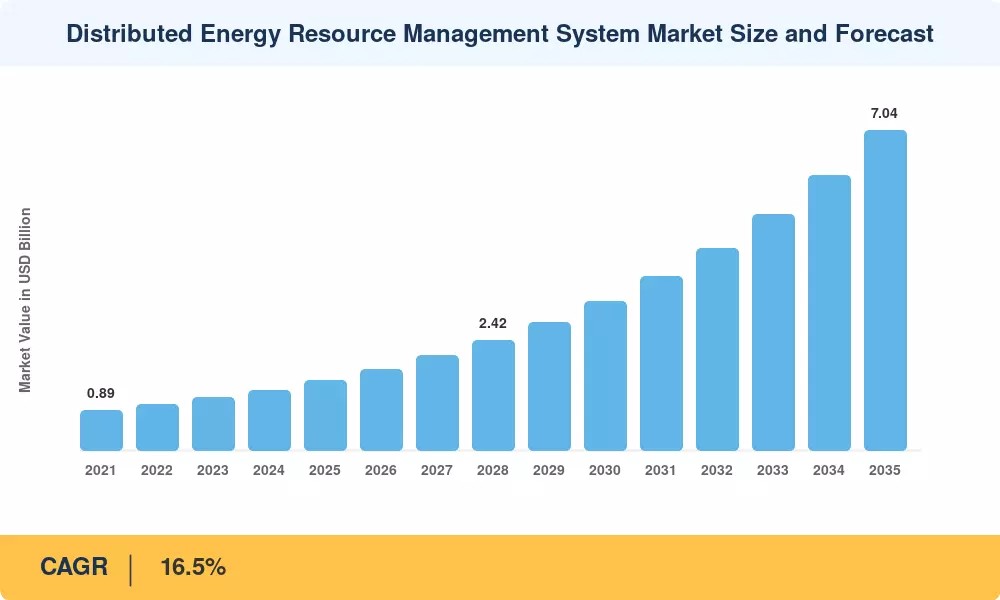
Distributed Energy Resource Management System Market to Reach USD 7.04 Billion by 2035 at 16.5% CAGR.
Distributed Energy Resource Management System Industry
Solar Photovoltaic represents the dominant technology segment, capturing approximately 42% of the Distributed Energy Resource Management System Market in 2025.
The Electric Vehicles segment is forecast to grow at a CAGR of 20.1% through 2035 as vehicle-to-grid programs scale across major economies.”
NEW YORK, NY, UNITED STATES, July 24, 2026 /EINPresswire.com/ -- The Distributed Energy Resource Management System Market reached an estimated USD 1.53 billion in 2025 and is projected to climb from USD 1.78 billion in 2026 to USD 7.04 billion by 2035, registering a CAGR of 16.5% across the forecast window.— Prashant Hake
Market Overview
Distributed Energy Resource Management Systems Industry are digital software platforms that enable utilities and grid operators to monitor, control, and optimize distributed energy resources (DERs) across the electricity distribution network. These systems orchestrate a diverse array of grid-edge assets, including rooftop solar photovoltaic systems, battery energy storage, electric vehicle chargers, microgrids, and demand-response resources. DERMS provide real-time visibility and control capabilities that traditional supervisory control and data acquisition (SCADA) systems cannot deliver, enabling grid operators to balance supply and demand, manage voltage and frequency, and coordinate DER participation in wholesale energy markets.
Growth Drivers
The market's robust growth is anchored in several converging forces. The aggressive expansion of renewable energy capacity—driven by the U.S. Inflation Reduction Act channeling over USD 370 billion toward clean energy and the European Union's Renewable Energy Directive mandating 42.5% renewables by 2030—has created unprecedented demand for systems that can manage intermittent, decentralized generation . Simultaneously, FERC Order 2222, which requires regional transmission organizations to permit DER aggregations in wholesale markets, has unlocked revenue streams for distributed assets, compelling utilities to deploy management platforms for compliance .
Grid modernization investments are accelerating market expansion. The U.S. Department of Energy committed USD 3.5 billion through the Grid Resilience and Innovation Partnerships program in 2024, signaling sustained federal support for digital grid infrastructure . The proliferation of electric vehicles—over 40 million units projected in the U.S. alone by 2030—adds another layer of complexity that DERMS platforms are uniquely equipped to handle, particularly as vehicle-to-grid programs scale across major economies .
Industry Trends & Technological Developments
The industry is witnessing a fundamental transition from rule-based scheduling to AI-driven predictive orchestration. Advanced analytics engines can now forecast solar generation deviations 72 hours ahead with sub-5% error margins, enabling operators to pre-position battery reserves and reduce curtailment losses by an estimated 12–18%. Cloud-native platforms are displacing legacy on-premises systems, offering scalability and lower total cost of ownership. Edge computing nodes are enabling sub-second dispatch decisions, critical for managing the bidirectional power flows introduced by distributed storage and EV charging infrastructure .
The integration of DERMS with broader grid management ecosystems—including Advanced Distribution Management Systems (ADMS), SCADA, and Energy Management Systems (EMS)—is becoming standard practice. Virtual power plant (VPP) aggregation capabilities are emerging as a key differentiator, enabling utilities to bid aggregated residential and commercial DER portfolios into wholesale energy and ancillary-services markets.
Policy & Regulatory Influence
Regulatory frameworks are the primary catalyst for market growth. FERC Order 2222, finalized in 2020 and entering phased compliance through 2026, requires regional transmission organizations to allow DER aggregations to participate in wholesale markets. This regulatory shift unlocks revenue streams for small-scale solar, battery, and demand-response assets that were previously excluded from ISO/RTO market clearing . Utilities in PJM, CAISO, and NYISO territories are deploying DERMS specifically to meet aggregation compliance timelines .
In Europe, the EU's Clean Energy Package requires member states to enable active consumer participation in energy markets, effectively mandating DER aggregation capabilities at the distribution level. The revised Renewable Energy Directive pushes the bloc toward 42.5% renewables by 2030, a goal that involves real-time coordination of millions of dispersed solar, wind, and storage assets . State-level mandates in California (SB 100, requiring 100% clean electricity by 2045) and similar policies in New York and Hawaii are further accelerating DERMS adoption in North America .
Demand Outlook
The demand outlook remains exceptionally strong, with the DERMS market forecast to grow at nearly 17% annually through 2035. North America, currently commanding approximately 38% of the market, is expected to maintain its leading position due to regulatory maturity and installed DER capacity . The Asia-Pacific region, however, is projected to register the highest CAGR at 19.2%, fueled by India's 500 GW non-fossil capacity target, China's smart grid investments, and aggressive renewable expansion across Southeast Asia. Europe holds the second-largest share at roughly 27%, with Germany, the UK, and the Nordics leading adoption .
Get Free Sample Report for Detailed Market Insights:
https://www.marketresearchfuture.com/sample_request/9621
Market Segmentation
The Distributed Energy Resource Management System Market is comprehensively segmented to capture diverse technology applications and end-user requirements.
By Technology
Solar Photovoltaic (PV): The dominant segment, capturing approximately 42% of the market in 2025, driven by declining panel costs, net-metering mandates, and the proliferation of rooftop and community solar installations . Distributed PV capacity has crossed 400 GW globally, and management platforms designed for solar-heavy portfolios command the largest vendor revenue share. Electric Vehicles (EVs): The fastest-growing technology segment at a projected CAGR of 20.1% through 2035, as V2G programs scale and fleet electrification accelerates . Bidirectional chargers can provide grid services worth USD 800–1,200 per vehicle annually, making EV integration a core DERMS use case. Microgrids: Contributed an estimated USD 0.32 billion in 2025, supported by federal resilience investments and campus-scale deployments across military bases, hospitals, and university campuses . Other Technologies: Includes demand response, wind, and small hydro integration, accounting for approximately 13% of the market.
By End-User
Utilities: The largest end-user segment, accounting for approximately 52.9% of market spending in 2025, driven by the need to integrate distributed generation while maintaining grid reliability . Industrial: Holds roughly 38% of total spending, reflecting demand from energy-intensive manufacturing, mining, and logistics operations seeking to optimize energy consumption and participate in demand-response programs . Commercial: Expanding at a CAGR of 17.2% as commercial buildings—offices, retail centers, hospitals, universities—integrate onsite generation and participate in grid flexibility programs . Residential: Growing at 18.7% as smart home ecosystems integrate with utility-facing DER orchestration platforms .
You can buy this market report at:
https://www.marketresearchfuture.com/checkout?currency=one_user-USD&report_id=9621
Regional Analysis
North America
North America dominates the DERMS market, commanding approximately 38% of global revenue in 2025, with the United States accounting for roughly 72% of regional share . The region's leadership is anchored by regulatory mandates in California, New York, and Texas, combined with FERC Order 2222 compliance deadlines driving ISO/RTO-level platform procurement . The U.S. boasts over 39.5 GW of small-scale solar capacity as of 2022, creating substantial management complexity that utilities are addressing through DERMS deployments . Canada's federal carbon pricing backstop and British Columbia's CleanBC program are stimulating platform adoption, while Mexico's energy reform trajectory continues to attract distributed solar investment. In January 2026, Yield Energy introduced its agriculture-based DERMS system, helping farms optimize distributed resources and participate in grid services .
Europe
Europe holds the second-largest share at approximately 27%, with Germany, the UK, France, Italy, and the Nordics leading adoption . The region's DERMS market benefits from a deeply integrated regulatory framework under the EU's Clean Energy Package and the revised Renewable Energy Directive, which mandates 42.5% renewables by 2030. Germany's Energiewende has produced over 2.5 million rooftop solar installations, while the UK's Flexibility Exchange and Demand Flexibility Service programs are pioneering market-based mechanisms that compensate aggregated DER portfolios for grid-balancing services. The European Commission's target to reduce greenhouse gases by 55% by 2030 relative to 1990 levels is driving sustained investment in digital grid technologies .
Asia-Pacific
Asia-Pacific is the fastest-growing regional market, projected to register a CAGR of 19.2% through 2035, fueled by India's 500 GW non-fossil capacity target, China's 14th Five-Year Plan investments in smart distribution networks, and aggressive renewable expansion across Southeast Asia . China accounts for roughly 35% of regional share, driven by its smart grid rollout and manufacturing dominance. India's renewable capacity additions and smart city initiatives are creating substantial demand, supported by the PM-KUSUM program and the country's 500 GW target. Japan's post-Fukushima energy strategy has prioritized decentralized resources, with over 80 GW of solar PV installed by 2024. In 2025, Smarter Grid Solutions (a Mitsubishi Electric subsidiary) partnered with Clean Power Research to connect Strata Grid DERMS technology with the PowerClerk platform, simplifying DER registration and enabling real-time management .
Rest of the World
Latin America and the Middle East & Africa represent emerging markets with significant potential. Brazil accounts for the bulk of South American DERMS activity, driven by over 2 million small-scale solar connections under the country's distributed generation framework. The Middle East is accelerating resilience and urban electrification investments, with Saudi Arabia's NEOM and The Line projects incorporating smart microgrid architectures. Africa is deploying off-grid and mini-grid solutions requiring lightweight, cloud-hosted management platforms, supported by the World Bank's USD 1 billion commitment to distributed electrification programs across 30 countries.
Competitive Landscape / Key Players
The DERMS market exhibits medium concentration, with an estimated top-five vendor share of 35–42% . The competitive field includes large industrial conglomerates with broad energy portfolios competing alongside specialized software-native entrants. M&A activity has consolidated several independent DER software companies into larger parent platforms since 2021 .
Key Companies
Siemens AG: Offers integrated OT/IT energy platforms with global utility relationships .
GE Vernova: GridOS DERMS platform with ISO/RTO market integration capabilities .
Schneider Electric: AI-driven flexibility management for commercial and industrial users .
ABB Ltd: Strong substation-to-meter technology stack .
Hitachi Energy: Lumada Energy Suite with Japanese utility partnerships .
Honeywell International: Building-to-grid integration with facilities management heritage .
Oracle Corporation: SaaS-native DERMS Cloud with billing and CIS integration .
Itron Inc.: AMI-centric data layer with edge computing capabilities .
Open Access Technology International (OATI): Wholesale market interface for DER aggregation compliance .
Generac Power Systems: Residential prosumer aggregation and VPP management .
Strategic Developments
Leading companies are investing in modular platforms that integrate edge hardware, telemetry services, and analytics-driven applications. In July 2023, Schneider Electric partnered with Pacific Gas and Electric Company to implement a DERMS on Microsoft Azure, enhancing grid reliability and promoting DER adoption . In June 2024, Hitachi Energy announced an additional USD 4.5 billion investment in manufacturing, engineering, digital, R&D, and partnerships by 2027, doubling investments from the prior three years . GE Vernova completed the integration of Opus One Solutions into its GridOS platform in October 2024, creating a unified DER management and market participation layer for North American utilities .
Latest Industry News & Developments
GE Vernova Completes Opus One Integration (October 2024): GE Vernova finalized the integration of Opus One Solutions into its GridOS platform, enhancing grid-edge orchestration with ISO/RTO market integration capabilities .
Hitachi Energy Announces USD 4.5 Billion Investment (June 2024): Hitachi Energy committed an additional USD 4.5 billion through 2027 to expand manufacturing, engineering, and R&D, doubling its prior three-year investment .
Yield Energy Introduces Agriculture-Based DERMS System (January 2026): Yield Energy launched a DERMS platform optimized for agricultural operations, helping farms manage distributed energy resources and participate in grid services .
Market Challenges & Opportunities
Key Restraints
Interoperability and Standards Fragmentation: The absence of a universal communication protocol—with IEEE 2030.5, OpenADR, and SunSpec Modbus each addressing different segments of the DER stack—forces platform vendors to build costly multi-protocol adapters. An EPRI study estimated that interoperability gaps add 15–22% to integration project timelines, deterring smaller utilities from committing to full-scale deployments. High Upfront Integration Costs: Full DERMS implementation for a mid-tier utility can cost USD 8–15 million for platform license, systems integration, and employee training, posing significant barriers for rural cooperatives and municipal utilities with limited capital budgets . Cybersecurity Risks: Each connected inverter, smart meter, or EV charger introduces additional attack surfaces, requiring continuous investment in cybersecurity frameworks and compliance with NERC CIP and NIS2 standards. Workforce Skills Gap: Limited availability of skilled personnel to implement, manage, and optimize DERMS remains a significant barrier to adoption .
Emerging Opportunities
Virtual Power Plant Aggregation: VPPs represent one of the most commercially compelling use cases, aggregating residential solar, batteries, and flexible loads into dispatchable portfolios that can bid into wholesale energy markets. Tesla's South Australia VPP has demonstrated that aggregated DER portfolios can displace peaking gas plants, validating the economic case for utility-scale VPP orchestration. Vehicle-to-Everything (V2X) Energy Services: As EV penetration crosses critical mass, bidirectional charging unlocks a distributed flexibility resource that grid operators will need dedicated platforms to manage. This segment stands to capture incremental revenue as automakers embed V2G-ready hardware and utilities launch time-of-use tariff programs . Emerging-Market Grid Leapfrogging: Sub-Saharan Africa, Southeast Asia, and parts of Latin America are deploying microgrids and mini-grids as alternatives to centralized grid extension, creating a greenfield addressable market for lightweight, cloud-hosted DERMS platforms that can operate in low-connectivity environments. Data Monetization and Grid-Edge Analytics: Insurance underwriters, equipment manufacturers, and carbon credit verifiers find substantial commercial value in DER telemetry, creating potential for anonymized data-as-a-service revenue streams independent of utility software licensing.
To explore more market insights, visit us at:
https://www.marketresearchfuture.com/reports/distributed-energy-resource-management-system-market-9621
Final Market Summary
The Distributed Energy Resource Management System Market is positioned for exceptional growth, with projections indicating a near-fivefold increase from USD 1.53 billion in 2025 to USD 7.04 billion by 2035, at a robust CAGR of 16.5%. This extraordinary expansion is driven by aggressive renewable energy mandates, regulatory frameworks such as FERC Order 2222 and the EU Renewable Energy Directive, and massive investments in smart grid modernization and EV infrastructure. While challenges including interoperability fragmentation, high integration costs, and cybersecurity risks persist, emerging opportunities in virtual power plants, V2X services, and emerging-market grid leapfrogging offer substantial potential for industry participants. The future market landscape will be defined by companies that successfully develop integrated, secure, and scalable platforms, navigate evolving regulatory requirements, and deliver modular solutions across diverse utility, industrial, commercial, and residential applications. North America will continue to lead in regulatory maturity, while Asia-Pacific is set to dominate global growth, driven by rapid industrialization and large-scale renewable expansion in China and India.
More Related Reports from MRFR Library:
Wired Drill Pipe Market: https://www.marketresearchfuture.com/reports/wired-drill-pipe-market-4016
Micro Turbine Market: https://www.marketresearchfuture.com/reports/micro-turbine-market-4099
Pipeline Monitoring System Market: https://www.marketresearchfuture.com/reports/pipeline-monitoring-system-market-4141
Contactor Market: https://www.marketresearchfuture.com/reports/contactor-market-4143
Energy Harvesting Trees Market: https://www.marketresearchfuture.com/reports/energy-harvesting-trees-market-4222
Arc Flash Protection System Market: https://www.marketresearchfuture.com/reports/arc-flash-protection-system-market-4256
Solid Oxide Fuel Cell Market: https://www.marketresearchfuture.com/reports/solid-oxide-fuel-cell-market-4281
Surge Arrester Market: https://www.marketresearchfuture.com/reports/surge-arrester-market-4298
Drilling Fluids Market: https://www.marketresearchfuture.com/reports/drilling-fluids-market-4329
Combined Heat and Power Market: https://www.marketresearchfuture.com/reports/combined-heat-power-market-4361
Larry Wilson
WantStats Research And Media Pvt. Ltd.
+ +1 855-661-4441
email us here
Visit us on social media:
LinkedIn
Facebook
YouTube
X
Legal Disclaimer:
EIN Presswire provides this news content "as is" without warranty of any kind. We do not accept any responsibility or liability for the accuracy, content, images, videos, licenses, completeness, legality, or reliability of the information contained in this article. If you have any complaints or copyright issues related to this article, kindly contact the author above.
