

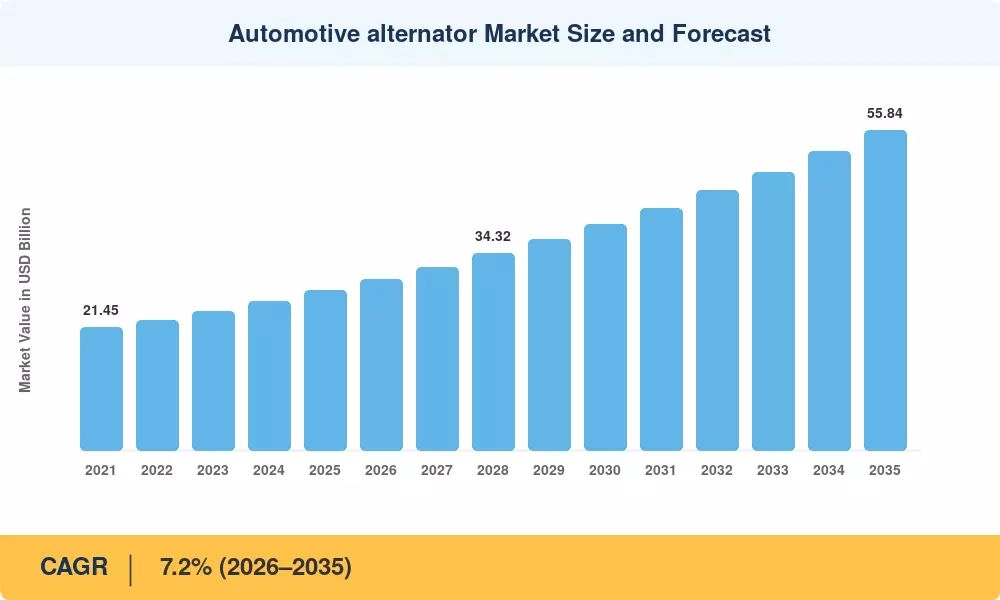
Automotive Alternator Market to Reach USD 55.84 Billion by 2035, Growing at 7.2% CAGR
Automotive Alternator Market
Asia-Pacific commands the leading position in the Automotive Alternator Market, with China alone representing over 22% of global value.
NEW YORK, NY, UNITED STATES, September 1, 2026 /EINPresswire.com/ -- According to Market Research Future, the Automotive Alternator Market is projected to grow from USD 29.86 Billion in 2026 to USD 55.84 Billion by 2035, registering a CAGR of 7.2% during the forecast period, driven by Integration of advanced energy management systems. This steady growth reflects the ongoing evolution of automotive electrical systems, where alternators are adapting to meet the increasing power demands of modern vehicles while supporting the transition toward hybrid and electrified powertrains.Market Overview
Automotive alternators are electromechanical devices that convert mechanical energy from the engine's crankshaft into electrical energy, providing power to the vehicle's electrical systems and maintaining battery charge. They are critical components in internal combustion engine vehicles and hybrids, with demand supported by a massive global vehicle parc exceeding 1.9 billion light vehicles, an aging vehicle fleet, and the growing electrical complexity of modern automobiles. As vehicles incorporate more electronic features—including ADAS sensors, infotainment systems, electric power steering, and heated seats—the average electrical power requirement per car has increased from approximately 1.5 kW in 2015 to over 3 kW in luxury vehicles today.
The key growth drivers propelling this market expansion include the rising global vehicle production and expanding vehicle parc, which sustain demand across both OEM and aftermarket channels. The growing adoption of advanced vehicle features, such as electric power steering, adaptive lighting, and electric turbochargers, is increasing the electrical load on vehicles and driving demand for higher-output alternators. The expansion of 48V mild-hybrid architecture—a cost-effective electrification pathway—is creating opportunities for advanced belt-driven starter-generators that rely on alternator-derived power conversion technology. Additionally, the strong automotive aftermarket, supported by extended vehicle lifespans and high replacement rates, continues to generate steady demand.
Technological developments are reshaping the alternator landscape. Smart alternators with integrated voltage regulators and intelligent charging capabilities are gaining traction, enabling real-time performance monitoring and optimized energy efficiency. Manufacturers are developing lightweight and compact designs using advanced materials to improve fuel efficiency and support vehicle electrification goals. The Automotive Battery Market is closely intertwined with alternator development, as the growing adoption of start-stop systems and energy recovery technologies relies on efficient charging systems.
📍 Get Free Sample Report for Detailed Market Insights:
https://www.marketresearchfuture.com/sample_request/1973
Market Segmentation
The automotive alternator market is segmented based on powertrain type and vehicle type to provide comprehensive insights into the industry landscape.
By Powertrain Type: The market is categorized into Internal Combustion Engine Vehicles and Hybrid and Electric Vehicles. ICE vehicles currently dominate the market due to the vast number of legacy vehicles and continued production of gasoline and diesel vehicles globally. The strong aftermarket demand from aging vehicles and replacement needs sustains this segment. However, hybrid vehicles represent the fastest-growing segment, as the expansion of 48V mild-hybrid architecture creates demand for advanced belt-driven starter-generators and integrated power modules. Electric vehicles are also influencing the market as onboard DC-DC converters replace conventional alternators, though the global ICE phase-out is well beyond 2035 in most jurisdictions.
By Vehicle Type: The market serves Passenger Cars and Commercial Vehicles segments. Passenger cars account for the largest share, driven by high global production volumes and the growing demand for comfort, safety, and infotainment features that increase electrical load. Commercial vehicles represent a significant and growing segment, requiring alternators capable of supporting heavy-duty electrical systems including engine control units, lighting, telematics, and fleet management systems. Commercial vehicles often require higher-output alternators (180 A to 250 A units are now standard in full-size trucks and SUVs) due to their extended duty cycles and heavy electrical loads.
By Sales Channel: The market is divided into OEM and Aftermarket segments. The OEM segment holds a significant share due to established relationships with major automakers and consistent demand from new vehicle production. The aftermarket segment is growing rapidly, driven by an aging vehicle fleet, rising consumer awareness regarding maintenance, and the need for replacement parts. The aftermarket and remanufactured segments are expected to outpace OEM growth, particularly as vehicles produced during periods of rapid market expansion age.
By Region: The market analysis covers North America, Europe, South America, Asia Pacific, and the Middle East and Africa.
🛒 You can buy this market report at:
https://www.marketresearchfuture.com/checkout?currency=one_user-USD&report_id=1973
Regional Analysis
Asia Pacific is the dominant regional market, driven by strong vehicle production bases, expanding automotive aftermarkets, and increasing demand for passenger and commercial vehicles. China plays a pivotal role due to its large-scale vehicle manufacturing and push toward electric and hybrid vehicles, which has accelerated the need for advanced, energy-efficient alternators. India contributes significant momentum, with vehicle ownership and commercial mobility expanding rapidly. Japan and South Korea drive advanced alternator and mild-hybrid technology development, while Australia generates replacement demand from long-distance driving and harsh environmental conditions. The region's robust automotive supply chain and technical expertise in component production continue to attract global players seeking cost-effective manufacturing advantages.
North America represents a mature and strategically important market, with the United States serving as a key revenue driver. The market benefits from high vehicle usage rates and demand for performance-oriented upgrades. The region's developed aftermarket and increasing focus on vehicle maintenance support demand for replacement alternators. Mexico is emerging as a manufacturing hub and replacement market under the USMCA supply chain, supporting vehicle assembly, export logistics, and domestic service demand. Brazil anchors Latin American demand through domestic assembly, flex-fuel vehicles, commercial fleets, and a large vehicle parc operating across varied road and climate conditions.
Europe demonstrates steady growth due to strict emissions regulations, increasing electric vehicle demand, and the need for improved efficiency in high-end automotive markets. European CO₂ fleet-average targets tightening to 50 g/km by 2030 are driving the adoption of 48V mild-hybrid architecture, a cost-effective compliance pathway that supports advanced alternator and starter-generator demand. The United Kingdom, Germany, France, Italy, and Spain combine mature vehicle parc replacement with advanced start-stop, fuel-efficiency, and diagnostics technologies. Russia presents demand linked to harsh climates, older vehicles, commercial transport, and localized parts sourcing.
South America and the Middle East and Africa represent developing markets with growing potential. In Latin America, rising vehicle production in Brazil, Mexico, and Argentina drives alternator demand, while the expanding commercial vehicle sector in logistics, construction, and agriculture supports high-performance alternator needs. The Middle East and Africa benefit from increasing demand for commercial and off-road vehicles in mining, oil and gas, and agriculture, with strong reliance on imported vehicles fueling the aftermarket sector. The GCC electric vehicles market is growing, encouraging high-efficiency alternator development.
Competitive Landscape and Key Players
The automotive alternator market is moderately consolidated, featuring a mix of global Tier-1 suppliers, specialized manufacturers, and regional players competing through product innovation, manufacturing efficiency, and strategic partnerships.
Key players operating in this market include Robert Bosch GmbH, DENSO Corporation, Valeo SA, Mitsubishi Electric Corporation, Hitachi Astemo, Ltd., Hella GmbH & Co. KGaA (Forvia), BorgWarner Inc., and Motorcar Parts of America, Inc.. These industry leaders are investing heavily in research and development to improve alternator efficiency, reduce weight, and integrate advanced electronics for smart charging capabilities.
Strategic developments are reshaping the competitive landscape. Leading suppliers are extending beyond component manufacturing into calibration services, software tuning, and data-driven maintenance offerings that complement hardware sales. Companies are diversifying their product portfolios to include 48-volt belt starter-generators, intelligent voltage regulators, and DC-DC conversion technologies. Partnerships with automakers and continuous R&D investment are common strategies to support hybrid and electric vehicle architectures. Manufacturers are also focusing on aftermarket intelligence and AI-based demand planning to improve inventory placement and reduce stockouts.
Latest Industry News and Developments
Recent industry developments highlight the dynamic nature of the automotive alternator market. In July 2024, Valeo launched a 12V alternator SKU for electric vehicles, leveraging its extensive experience in the field. The new alternator employs synchronous rectification using MOSFET technology, which nearly eliminates voltage drop during current rectification. It has mass production capabilities ranging from 60 Amps to 300 Amps and features six phases to reduce magnetic noise. This product launch demonstrates how leading suppliers are adapting traditional alternator technology for emerging vehicle applications.
In November 2023, Bosch expanded its starter and alternator range to include a program of all types, significantly increasing market coverage for workshops. The expanded range caters to passenger cars and commercial vehicles across various European and Asian brands, simplifying inventory management and improving product availability.
In February 2023, BorgWarner Inc. announced the spin-off of its Fuel Systems and Aftermarket segments into a new publicly traded company named PHINIA Inc., focusing on power generation solutions across commercial, light vehicle, and aftermarket segments. These developments underscore the industry's commitment to innovation and adaptability in the evolving automotive landscape.
Market Challenges and Opportunities
The automotive alternator market faces several key challenges that could impact growth trajectories. Accelerating BEV adoption is displacing traditional alternator demand, as battery-electric vehicles replace 12V auxiliary power with onboard DC-DC converters. Raw-material cost volatility, particularly copper prices which surged 28% between January 2023 and March 2024, compresses Tier-1 supplier margins and constrains the transition toward premium high-efficiency units. Rare-earth permanent magnets used in brushless designs face supply-chain concentration risk, with China controlling over 70% of refined output. OEM vertical integration of power electronics—Toyota, Hyundai, and Honda have increased internal manufacturing of integrated power modules—reduces the addressable market for independent Tier-1 suppliers.
Emerging opportunities are abundant in the evolving automotive landscape. The 48V mild-hybrid architecture, adding only USD 800–1,200 per vehicle versus USD 8,000+ for full hybridization, has emerged as the most cost-effective compliance pathway for tightening emission standards. High-output alternators and smart regulators are in growing demand as modern electrical loads increase. Aftermarket digitization and predictive replacement models, enabled by connected-vehicle platforms that monitor alternator voltage output and bearing vibration, are creating opportunities for predictive-maintenance service models. Remanufacturing is becoming a strategic capability as circular economy expectations, cost-conscious consumers, and fleet maintenance economics support demand for remanufactured alternators.
To explore more market insights, visit us at:
https://www.marketresearchfuture.com/reports/automotive-alternator-market-1973
Final Market Summary
The automotive alternator market is positioned for steady growth, driven by the expanding vehicle parc, increasing electrical loads in modern vehicles, and the transition toward mild-hybrid architectures. The market's trajectory from USD 29.86 Billion in 2026 to USD 55.84 Billion by 2035 reflects the ongoing evolution of automotive electrical systems, where alternators continue to play a vital role in supporting vehicle efficiency, reliability, and advanced features.
The long-term industry potential remains robust, with advancements in smart charging systems, lightweight materials, and integrated power electronics continuing to expand the addressable market. The convergence of alternator technology with broader vehicle electrification, including 48V systems and hybrid powertrains, is creating opportunities for suppliers that invest in adjacent electrical architecture technologies.
Key factors expected to influence future development include the pace of electric vehicle adoption, the evolution of emission regulations, and the advancement of software-defined charging systems. The development of affordable, high-efficiency alternators and intelligent voltage regulators will support continued demand across both OEM and aftermarket channels. As vehicles become increasingly connected, electrified, and software-defined, the role of advanced power generation systems will continue to evolve, ensuring sustained innovation and growth throughout the forecast period and beyond.
More Related Reports from MRFR Library:
Spark Plug Market : https://www.marketresearchfuture.com/reports/spark-plugs-market-1931
Automotive Exhaust System Market : https://www.marketresearchfuture.com/reports/automotive-exhaust-system-market-1943
Vehicle Camera Market : https://www.marketresearchfuture.com/reports/vehicle-camera-market-1953
Automotive Bearing Market : https://www.marketresearchfuture.com/reports/automotive-bearing-market-1996
Automotive Metal Stamping Market : https://www.marketresearchfuture.com/reports/automotive-metal-stamping-market-2002
Driver Safety Market : https://www.marketresearchfuture.com/reports/driver-safety-market-2007
Biometric Vehicle Access Market : https://www.marketresearchfuture.com/reports/biometric-vehicle-access-market-2032
Vehicle Anti Theft Market : https://www.marketresearchfuture.com/reports/vehicle-anti-theft-market-2036
Hybrid Power Solution Market : https://www.marketresearchfuture.com/reports/hybrid-power-solution-market-2053
Passenger Car Sensors Market : https://www.marketresearchfuture.com/reports/passenger-car-sensors-market-2118
Market Research Future
Market Research Future
+1 855-661-4441
email us here
Legal Disclaimer:
EIN Presswire provides this news content "as is" without warranty of any kind. We do not accept any responsibility or liability for the accuracy, content, images, videos, licenses, completeness, legality, or reliability of the information contained in this article. If you have any complaints or copyright issues related to this article, kindly contact the author above.
